
Our History
It is no surprise as to where Rupa Maker gets its inspiration from. It’s all around us. Coming from one of the most artistic cities in the world; we only had to look around our hometown ‘Patan’ to draw inspiration.

A centuries old city; Patan is renowned for the art it represents and the craftsmen it has groomed. Many Buddhists artists from around the world have showered opportunities to craftsmen here, trusting in their skills. The artistic culture of Patan is evident in the temples, in the chowk, in the old gallies and in homes.
Rabi Shakya and Rajesh Shakya; the founders of Rupa Maker were driven by the art they saw in the nooks and crannies of Patan. Both brothers were involved in statue making from a budding age to support their families. The passion was strong early on. And it gave roots to Rupa Maker.

Rabi Raj Shakya with H.H Kyabje Dungse Thinley Norbu Rinpoche.

Rabi Raj Shakya and Rajesh Shakya with H.H Kyabje Dungse Thinley Norbu Rinpoche.
What truly gave Rupa Maker the form of what was a mere idea is H H Dungse Thinley Norbu Rinpoche. During a visit, he came across the brothers’ work. H H Dungse Thinley Norbu Rhinpoche gave the brothers the belief and the push they needed. The brothers were trusted with making special statues for him which boosted their skills and their confidence to go ahead with their own business. Rupa Maker was established in 1991 and that opened the door to connect with many more practitioners.
With the establishment of Rupa Maker in a city that we can only suppose is an ocean of art and artists; we had to prove ourselves. Younger brother Saroj Shakya committed to find practitioners and have Rupa Maker stand out whilst the founding brothers made sure that we have the best statues to offer.

Rabi Raj Shakya and Rajesh Shakya with Lama Tsedrup Tharchin Rinpoche.
For three decades now, Rupa Maker has embraced every practitioner that have visited us and portrayed their beliefs. Inspiration and passion for craft is what makes Rupa Maker what it is today. But more than that we are the stories of our practitioners and their trust in us. We have been more than delighted to serve practitioners from all around the world.

Saroj Shakya with Richard Gere.
About Our Statues
All our statues use copper metal and are finished either in gold-plating, silver-plating or copper oxidation.


Gold-plating
The gold plating statues are either Full gold plating (FGP) or Part-gold plating (PGP). FGP covers the entire statue with gold. PGP covers only certain areas of the statue with gold.

Silver-plating
Silver-plating also consists of Full and part silver (FSP and PSP). FSP covers the entire statue while PSP covers certain areas of the statue.

Copper-Oxidation
The copper-oxidation does not include any other metal plated to it. The statue is finished in a dark chocolate color.

Two-toned finish
The two toned finish includes a mixture of dark chocolate finish and a lighter brownish finish. This Finish usually has a dark finish on the clothes of the statue, whereas the visible skin area is given a lighter brownish finish. This finish usually comes in just copper oxidized (CCT), Partly-gold plated (PTA) and Partly-silver plated (PST).


Our Blogs
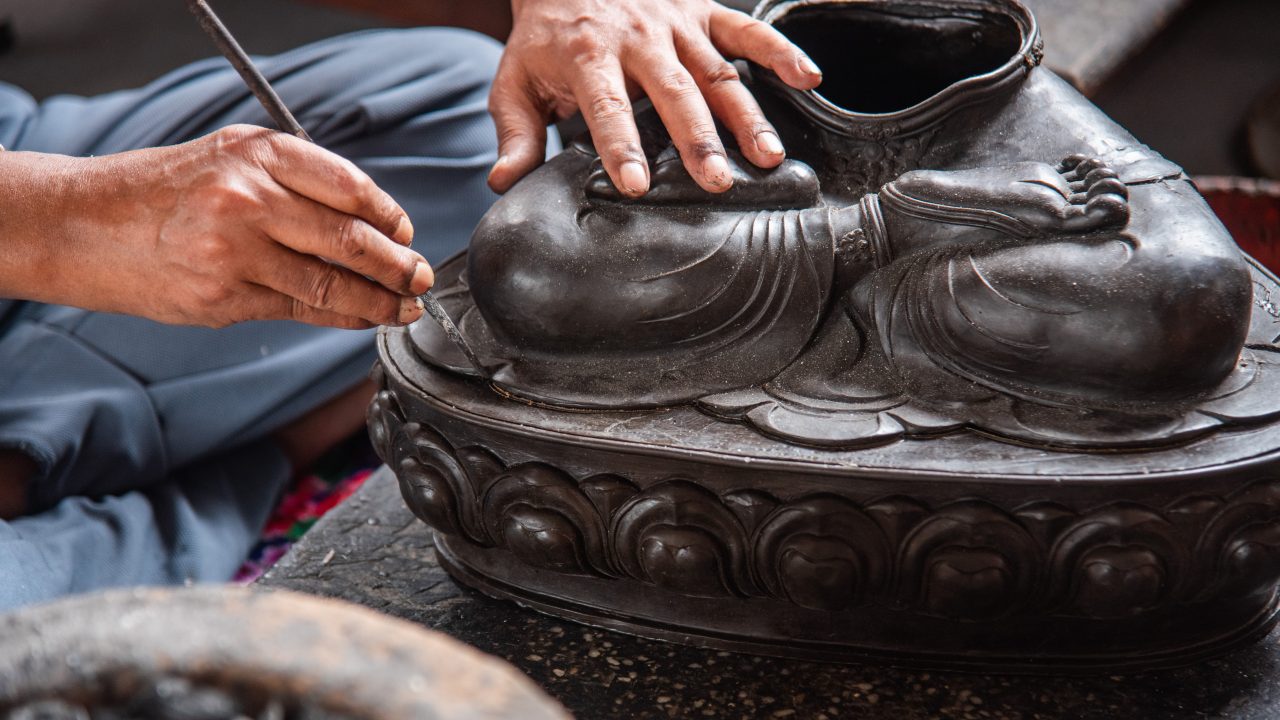
October 12, 2026RupaMaker
The First Stage of Statue Making: Creating the Wax Figure
Every Buddhist statue begins long before the metal is cast, the surface is carved, or the face is painted. Before a statue takes shape in copper, there is first a figure made in wax. This is where the proportions, posture, expression, garments, ornaments, and overall structure of the statue are established. Later, other craftsmen refine the metal, deepen the carving, apply the finish, and paint the face, but they all work with the form established at this first stage. At Vajra Rupa, we see wax figure creation as the foundation of the entire process. A beautifully finished statue depends not only on the skill of the craftsmen who work on it later, but also on the vision and ability of the artist who first gives it form.
The Artists Behind the Wax
There are different kinds of artists involved in creating Buddhist statues. An original artist can design a statue from scratch, developing the figure according to traditional iconography while bringing their own artistic ability to the work. Once the masterpiece wax figure is complete, the artist can make a mould directly from it and reproduce the wax figure for casting. Copy artists, on the other hand, generally begin with a completed metal statue. They make a mould from that statue and use it to reproduce the design. Some copy artists reproduce the original closely, while others introduce modifications or adjust certain details. There are also artists who do both, creating original designs for some statues and reproducing existing ones for others.
Creating an original design and reproducing an existing one require different skills. A copy artist has a model to follow and can concentrate on reproducing its proportions, details, and overall appearance. An original artist must make those decisions while building the figure, often without an existing model to guide them. They need to visualize the complete statue and work out how its different parts will come together in three dimensions. This requires patience, experience, and a particular artistic ability. Copying is not simply a mechanical task, however. Reproducing a statue accurately still requires considerable skill, especially when preparing and assembling the individual parts. The distinction lies in where the design begins and how much of its form the artist must establish independently.
From Beeswax to a Workable Material
The process begins with beeswax. In its natural form, beeswax needs to be prepared before it can be used to create the figure. It is mixed with sal dhup, a powdered material derived from the resin of the sal tree, to produce a wax mixture suitable for working. The artist melts the wax in a metal pot, using a gas stove, electric stove, or, in some workshops, a traditional coal burner. Once melted, the wax can be poured onto a stone or marble slab and left to cool until it can be lifted and worked by hand.
The cooled wax is kneaded and pounded with a stone, much like dough, until it forms a thin sheet. The artist can warm this sheet slightly to make it pliable before placing it into a mould to form the required part of the statue. Traditional tools, particularly buffalo horns, are used to work directly on the wax. Rulers and other measuring tools may also be used, although experienced artists sometimes rely on their familiarity with traditional proportions and their ability to judge measurements by eye. The tools themselves are relatively simple, but the skill lies in knowing how to use them and understanding how the wax responds to heat, pressure, and repeated adjustments.
Creating the Masterpiece
The first original wax figure is known as the masterpiece. Unlike a reproduction, it is created from scratch. The artist must establish the design, proportions, posture, and details through their own knowledge and ability. Although moulds are used to form individual parts, they do not replace the original artist’s work in designing the statue. The artist must first determine what the figure should look like and how its different elements will fit together.
Buddhist statues are made within established iconographic traditions. Their proportions, postures, hand gestures, attributes, ornaments, and other essential characteristics are guided by traditional systems and texts passed down through generations. In practice, however, the wax artist does not necessarily consult these texts directly while working. The knowledge is generally learned through training and experience, while images of deities—both two-dimensional references and existing three-dimensional statues—help guide the design. For commissioned work, the client may also provide additional images or specific requirements.
Measurements are an important part of this process. Artists learn traditional proportions from their teachers and use tools to mark them while developing the figure. With experience, many of these measurements become so familiar that the artist can recall and apply them almost instinctively. The measurements vary according to the deity and the form being created; some figures share similar proportions, while others follow distinct systems. Even when the measurements are established, the artist still has to make the figure work as a whole. Two artists can create the same deity while producing noticeably different results because their understanding of form, working methods, and artistic judgment differ.
There is room for individual expression within traditional iconographic boundaries. The essential features and attributes of the deity must be maintained, but artists may interpret aspects of the face, crown, ornaments, and other details in their own ways, provided those choices remain consistent with the tradition. This is one reason an original artist’s work can have a distinctive character. Correct measurements and symmetry are important, but they do not automatically produce a compelling statue. A skilled artist knows how to balance the head, body, limbs, posture, and ornaments so that the entire figure feels coherent. The proportions work together, and the design has a quality that can be difficult to explain through measurements alone.
The artist usually begins by establishing the basic form of the figure, including the head, body, and legs, although the order can vary. From there, the different sections are developed and brought together. Some artists begin with the head, while others follow a different sequence depending on the statue. Hands, ornaments, crowns, and garment details may be made separately and attached later; some details can also be worked directly onto the figure. As the form develops, the artist repeatedly checks the proportions and makes adjustments. Wax is particularly useful because it can be reheated, reshaped, removed, or replaced whenever something does not look right. The figure remains a work in progress until its structure and appearance satisfy the artist.
Commissioned designs can involve several rounds of discussion and adjustment. The artist may present the wax figure to the client, receive feedback, and make changes before presenting it again. Three rounds of revisions or more are common, although occasionally a design is accepted much earlier. These exchanges are part of translating someone’s vision into a physical form. For the artist, creating an original figure also involves uncertainty: the design may need to be reworked several times before its proportions, expression, and overall structure come together as intended.
From Masterpiece to Reproduction
Once the masterpiece wax figure is complete, a mould can be made directly from it. Both wax and rubber moulds can be used, and artists may alternate between them depending on their working methods and requirements. Wax moulds belong to older mould-making techniques, while rubber moulds are a much newer development. Rubber is flexible and convenient to work with, although it gradually deteriorates with repeated use. Harder wax moulds behave differently and can be more durable, depending on how they are made and maintained.
The original artist uses the mould to reproduce wax figures based on the masterpiece. These reproduced figures are then prepared for casting. Although the mould establishes the main shape, the work does not end when a wax figure is removed from it. The figure may consist of several separate sections, which must be assembled, joined with wax, and refined. The artist works over the lines where the pieces meet, blends the joints, and removes unwanted seams so that the figure accurately represents the intended design. Hands, ornaments, and other details are attached separately. Even when the design already exists, the artist must ensure that each reproduced figure is properly assembled and prepared for casting.
The process differs when a copy artist begins with a completed metal statue. Rather than taking a mould from the original masterpiece wax figure, the copy artist makes a mould directly from the existing metal statue. This mould is then used to reproduce the design. The resulting metal figure can, in turn, become the reference for another mould, allowing the process to continue across successive generations of copies. Original artists can use moulds to reproduce their own designs, while copy artists can reproduce completed statues created by other artists. Both may use wax or rubber moulds, depending on the process.
With each generation of copying, the statue can become slightly smaller. One important reason is the contraction that occurs as molten metal cools and solidifies. When another mould is made from the resulting metal figure, and the process is repeated, these small changes can accumulate. The extent of the reduction depends on the materials and methods used, but over successive generations, later copies may become noticeably smaller than the earlier statue. This means that a statue’s design can have a lineage, from the original artist’s masterpiece wax figure to the first metal statue and then to later reproductions.
The design may also change along the way. Some artists reproduce the form closely, while others introduce modifications that give a copy its own character. Some artists specialize in reproducing existing statues, while others alternate between copying and creating their own designs. The distinction between original and copy is therefore not always a simple division between artists who create and artists who reproduce. It reflects different approaches to the craft, each requiring its own knowledge and skill.
Why the Wax Figure Matters
By the time a finished statue reaches a shrine or collection, the wax has long since disappeared. The metal has been refined and carved, the surface may have been gilded or given an antique finish, and the face may have been painted by a specialist. Yet the overall form established in the wax remains the foundation for everything that follows.
A skilled metal carver can refine the face, correct certain imperfections, sharpen the details, and bring greater definition to the statue. But carving cannot completely overcome a weak underlying design. If the proportions are unbalanced or the overall structure does not work, later craftsmanship can improve the statue only so far. Conversely, when an artist creates a strong wax figure, the design can already be compelling before the detailed metal carving begins. The relationship between the head and body, the balance of the posture, and the overall silhouette give the statue its character from the outset.
This is why the first stage deserves particular attention. Wax figure creation is not merely a preliminary step before the statue becomes metal. It is where the artist’s understanding of the deity, knowledge of traditional proportions, and personal ability come together to establish the form. Every craftsman who works on the statue afterward builds upon that foundation.
Once the wax figure has been completed and prepared, it is ready for the next stage: casting the design into metal. In the next article, we will look at how the wax figure is used in the lost-wax casting process and how the original form emerges as a rough metal statue.
Latest Blogs
The First Stage of Statue Making: Creating the Wax Figure
October 12, 2026
Reading the Sacred Image of Guru Padmasambhava
July 31, 2026

The Journey of Creating a 48-Inch Guru Rinpoche Statue
February 27, 2025
Categories
- Events (1)
- Guide (1)
- Iconography (3)
- Uncategorized (1)

Subscribe
Subscribe to our newsletter to get the latest updates. If you'd like to connect with us, please do not hesitate. We are happy to hear from you. You will also find Rupa Maker on Facebook, Instagram.
