
Our History
It is no surprise as to where Rupa Maker gets its inspiration from. It’s all around us. Coming from one of the most artistic cities in the world; we only had to look around our hometown ‘Patan’ to draw inspiration.

A centuries old city; Patan is renowned for the art it represents and the craftsmen it has groomed. Many Buddhists artists from around the world have showered opportunities to craftsmen here, trusting in their skills. The artistic culture of Patan is evident in the temples, in the chowk, in the old gallies and in homes.
Rabi Shakya and Rajesh Shakya; the founders of Rupa Maker were driven by the art they saw in the nooks and crannies of Patan. Both brothers were involved in statue making from a budding age to support their families. The passion was strong early on. And it gave roots to Rupa Maker.

Rabi Raj Shakya with H.H Kyabje Dungse Thinley Norbu Rinpoche.

Rabi Raj Shakya and Rajesh Shakya with H.H Kyabje Dungse Thinley Norbu Rinpoche.
What truly gave Rupa Maker the form of what was a mere idea is H H Dungse Thinley Norbu Rinpoche. During a visit, he came across the brothers’ work. H H Dungse Thinley Norbu Rhinpoche gave the brothers the belief and the push they needed. The brothers were trusted with making special statues for him which boosted their skills and their confidence to go ahead with their own business. Rupa Maker was established in 1991 and that opened the door to connect with many more practitioners.
With the establishment of Rupa Maker in a city that we can only suppose is an ocean of art and artists; we had to prove ourselves. Younger brother Saroj Shakya committed to find practitioners and have Rupa Maker stand out whilst the founding brothers made sure that we have the best statues to offer.

Rabi Raj Shakya and Rajesh Shakya with Lama Tsedrup Tharchin Rinpoche.
For three decades now, Rupa Maker has embraced every practitioner that have visited us and portrayed their beliefs. Inspiration and passion for craft is what makes Rupa Maker what it is today. But more than that we are the stories of our practitioners and their trust in us. We have been more than delighted to serve practitioners from all around the world.

Saroj Shakya with Richard Gere.
About Our Statues
All our statues use copper metal and are finished either in gold-plating, silver-plating or copper oxidation.


Gold-plating
The gold plating statues are either Full gold plating (FGP) or Part-gold plating (PGP). FGP covers the entire statue with gold. PGP covers only certain areas of the statue with gold.

Silver-plating
Silver-plating also consists of Full and part silver (FSP and PSP). FSP covers the entire statue while PSP covers certain areas of the statue.

Copper-Oxidation
The copper-oxidation does not include any other metal plated to it. The statue is finished in a dark chocolate color.

Two-toned finish
The two toned finish includes a mixture of dark chocolate finish and a lighter brownish finish. This Finish usually has a dark finish on the clothes of the statue, whereas the visible skin area is given a lighter brownish finish. This finish usually comes in just copper oxidized (CCT), Partly-gold plated (PTA) and Partly-silver plated (PST).


Our Blogs
July 31, 2026RupaMaker
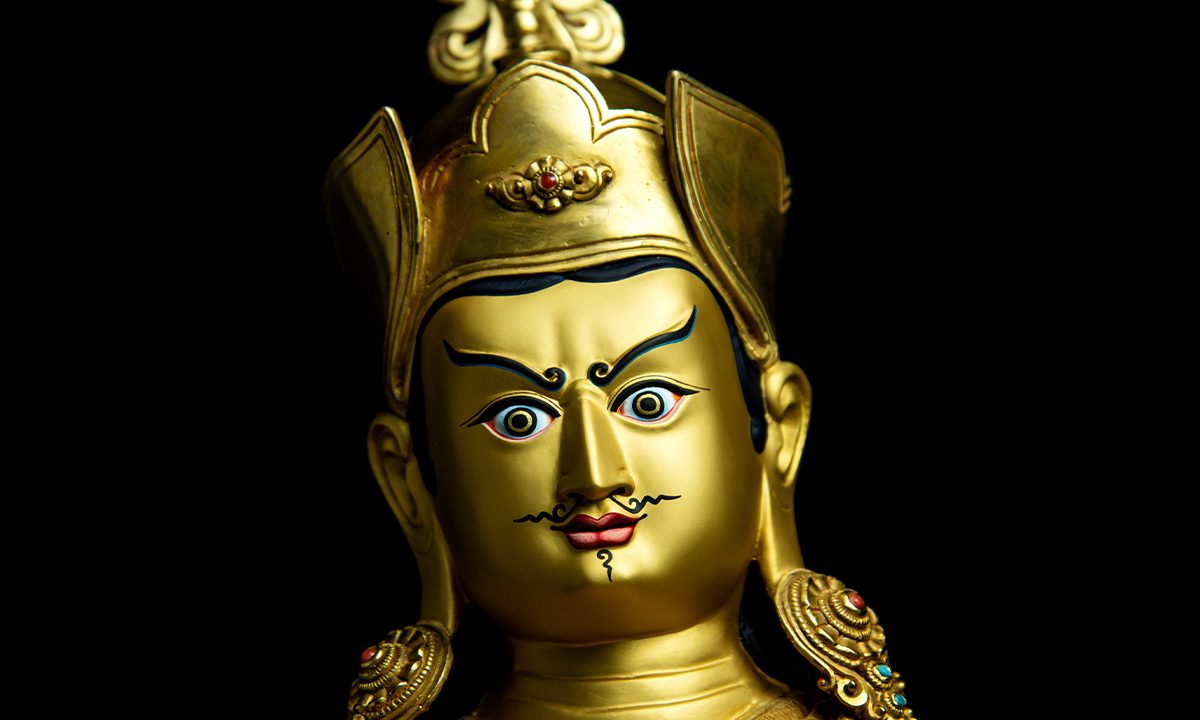
Reading the Sacred Image of Guru Padmasambhava
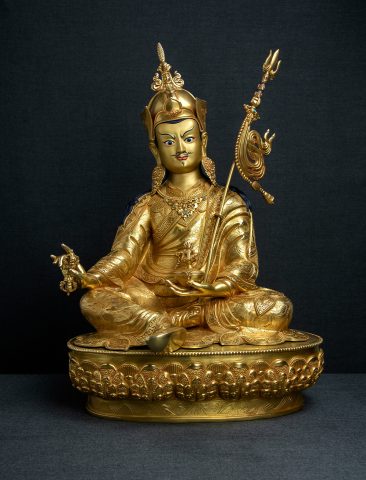
Walk into almost any Buddhist monastery or shrine in the Himalayan world and you are likely to encounter the image of Guru Padmasambhava. Seated gracefully upon a lotus throne, wearing his distinctive lotus hat and holding the vajra, skull cup, and khaṭvāṅga, his appearance is immediately recognizable to practitioners and admirers of Himalayan Buddhist art alike. Yet every element of this sacred image has been carefully preserved through centuries of artistic tradition. Nothing is placed by chance, and nothing is merely decorative.
For those of us who create Buddhist statues, understanding this iconography is one of the most important parts of the artistic process. Before wax is modelled, before metal is cast, and before the fine details are carved, the sculptor must first understand the form being represented. The posture, garments, facial expression, ritual implements, and ornaments all follow established conventions that have been transmitted through generations of artists and teachers. While individual artistic styles may vary, these essential characteristics remain remarkably consistent.
At Rupamaker, we are privileged to work alongside master Newar artisans whose knowledge has been handed down through centuries of Buddhist craftsmanship in the Kathmandu Valley. Their work is not simply an expression of artistic skill but a continuation of a living tradition that values both beauty and iconographic accuracy. When we create a statue of Guru Padmasambhava, we are not inventing an image; we are preserving one.
This article explores the iconography of Guru Padmasambhava through the eyes of the maker. Rather than attempting to explain Buddhist philosophy or practice, we invite you to look closely at the sacred image itself and discover the traditional features that have guided its creation for centuries.
Who is Guru Padmasambhava?
Within the Buddhist tradition, Guru Padmasambhava, also known as Guru Rinpoche or the “Precious Master,” is revered as one of the great masters responsible for establishing Vajrayana Buddhism in Tibet during the eighth century. Traditional accounts describe how he travelled from the land of Oḍḍiyāna at the invitation of King Trisong Detsen, working alongside the Indian scholar Śāntarakṣita to help establish Samye, Tibet’s first Buddhist monastery.
According to these traditional biographies, Guru Padmasambhava miraculously appeared upon a blooming lotus, giving rise to the name Padmasambhava, meaning “Lotus-Born.” His life and activities have since been preserved through sacred biographies, oral traditions, and terma literature, and his image continues to be revered throughout Nepal, Tibet, Bhutan, Mongolia, and the wider Himalayan world.
Although different Buddhist lineages preserve their own traditions and representations, the essential iconographic features of Guru Padmasambhava have remained remarkably consistent. Whether represented in paintings, murals, or sculpture, these carefully preserved characteristics allow artists and practitioners alike to recognize his sacred image immediately.
The Lotus Hat
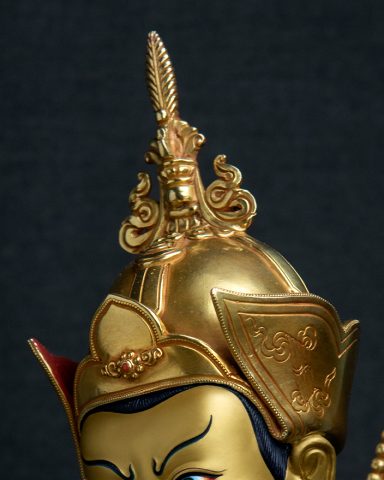
One of the defining features of Guru Padmasambhava’s iconography is his distinctive lotus hat. According to traditional accounts, it was offered to him by the King of Zahor and is traditionally depicted with gracefully rising side panels, richly ornamented brocade, flowing silk streamers, a half vajra at its crown, and a vulture feather emerging from the top. Together, these elements have become closely associated with the Lotus-Born Master throughout Himalayan Buddhist art. While this lotus hat is the form most commonly seen in statues and paintings, some traditions preserve different styles of headwear. For example, the well-known Ngadrama image of Guru Padmasambhava depicts him wearing a Pandita hat rather than the traditional lotus hat, illustrating the diversity found within different iconographic traditions and lineages.
The Face
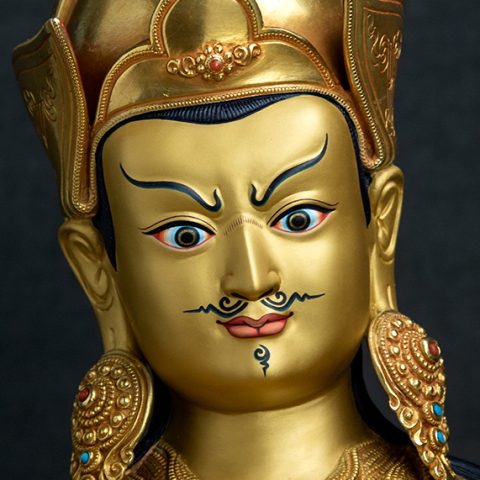
The face of Guru Padmasambhava expresses a harmonious balance of dignity, serenity, and compassionate strength. His eyes are traditionally portrayed wide open in a steady, penetrating gaze, reflecting unwavering awareness and enlightened activity. In some artistic traditions, however, the eyes are rendered with a softer and more peaceful expression while still preserving the essential character of the sacred image. Likewise, while Guru Padmasambhava is most commonly depicted with a gentle smile that conveys compassion, inner peace, and confidence, certain representations portray him with a wide open mouth, similar to the expression seen in wrathful deities, emphasizing a more dynamic aspect of enlightened activity.
Another distinctive feature is the curved form above the upper lip. Although commonly described as a moustache in art historical literature, some Buddhist masters explain that it represents the subtle movement of breath flowing from Guru Padmasambhava’s nose rather than facial hair. While this interpretation belongs to particular oral traditions, it remains a meaningful explanation preserved by some teachers and artists.
For sculptors, the face is often the most demanding part of the entire statue. A slight adjustment to the eyes or the expression can transform the character of the image entirely. Achieving the right balance requires not only technical skill but also a deep understanding of the iconographic tradition that has guided the depiction of Guru Padmasambhava for centuries.
The Garments
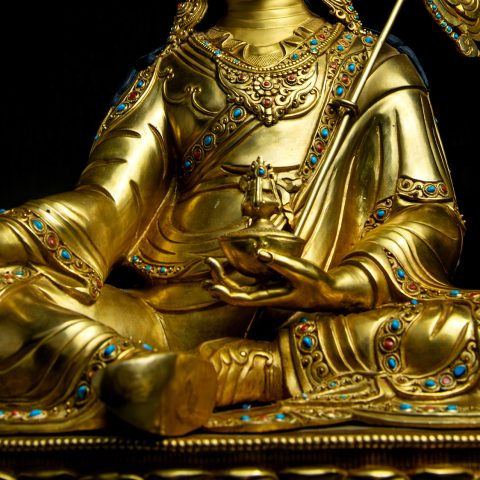
Another distinctive aspect of Guru Padmasambhava’s iconography is his attire. Traditional descriptions speak of seven garments, although only a few layers are immediately visible in most statues and paintings. At the neckline, a white inner garment can often be seen, symbolizing purity and the unstained nature of awakened mind. Draped over this is a deep blue robe, identifying Guru Padmasambhava as a Vajrayana master, while the maroon outer robe recalls the robes of an ordained Buddhist monk. Rich brocade, decorative borders, and flowing silk elements complete the attire, bringing together the appearance of a monk, a tantric adept, and an enlightened teacher.
For sculptors, these garments are more than decorative details. The arrangement of the robes, the folds of the fabric, and the embroidered borders all contribute to the identity of the sacred image and are carefully preserved according to established iconographic traditions.
The Body Posture
The form of Guru Padmasambhava most commonly represented in Himalayan Buddhist art is Nangsi Zilnön (Snang-srid Zil-gnon), in which he is seated in lalitāsana, or the posture of royal ease. One leg rests folded upon the lotus throne while the other extends naturally forward, expressing a figure that is both composed and ready to act. This is also the form most frequently commissioned and created by Newar artisans and the one most familiar to practitioners throughout the Himalayan Buddhist world.
Although the posture remains consistent, different terma traditions preserve subtle iconographic variations. In the Chokling Tersar tradition, Guru Padmasambhava is commonly depicted seated in lalitāsana while holding the vajra close to his heart. In the Tukdrub Barche Kunsel cycle, the vajra is often shown raised in a gesture of enlightened activity rather than resting upon the right knee as seen in the traditional Nangsi Zilnön form. These variations are not artistic inventions but lineage-specific iconographic conventions that have been faithfully preserved through generations.
For makers, identifying the correct form is one of the very first steps in creating a statue. Before modelling begins, the sculptor must understand which iconographic tradition the image follows, ensuring that every posture, gesture, and attribute faithfully represents the intended lineage.
The Sacred Implements
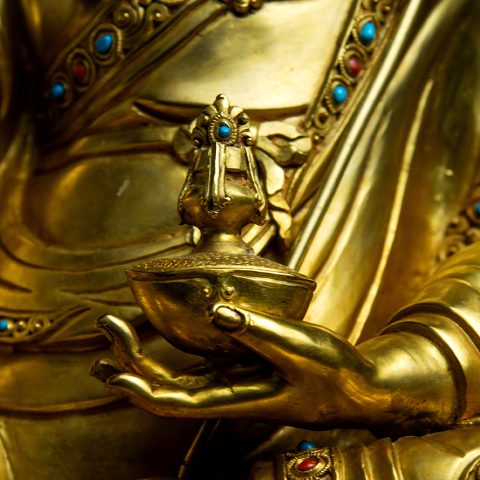
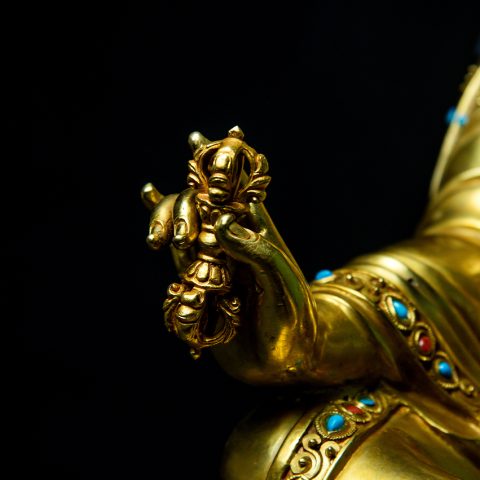
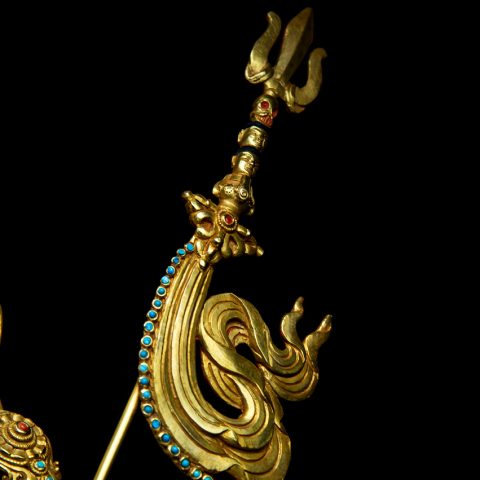
The ritual implements carried by Guru Padmasambhava are among the most recognizable elements of his iconography. In his right hand he holds a five-pronged vajra, one of the principal ritual implements of Vajrayana Buddhism and a symbol of indestructible wisdom. Resting in his left hand is a skull cup (kapāla) supporting a vase of longevity filled with the nectar of immortality, traditionally associated with longevity, realization, and the transformation of ordinary existence into wisdom. Leaning against his left shoulder is the khaṭvāṅga, a tantric staff crowned by a trident and adorned with symbolic ornaments, representing his identity as a fully accomplished Vajrayana master.
While each of these implements carries its own traditional symbolism, together they also serve another purpose: they identify the figure itself. Combined with the lotus hat and royal ease posture, these sacred attributes immediately distinguish Guru Padmasambhava from every other figure in Himalayan Buddhist art. For makers, reproducing them accurately is essential, ensuring that the finished sculpture remains faithful to the iconographic tradition it represents.
The Many Manifestations of Guru Padmasambhava
Although Guru Padmasambhava is often recognized through a familiar iconographic form, he is represented in numerous manifestations throughout the Tibetan Buddhist tradition. Each manifestation reflects a particular aspect of his enlightened activity and possesses its own iconographic characteristics, including variations in posture, attire, facial expression, hand gestures, and ritual implements.
Among the most well known are the Eight Manifestations (Guru Tsen Gye), which include Guru Tsokye Dorje, Guru Pema Gyalpo, Guru Loden Chokse, Guru Shakya Senge, Guru Nyima Özer, Guru Senge Dradrok, Guru Pema Jungne, and Guru Dorje Drolo. In addition to these, many terma traditions preserve lineage-specific forms of Guru Padmasambhava, each faithfully maintained according to its own textual and oral transmission.
The form described throughout this article is Nangsi Zilnön (Snang-srid Zil-gnon), the manifestation most commonly represented in Himalayan Buddhist sculpture and the form most frequently encountered in monasteries, temples, and personal shrines. While other manifestations differ in appearance, they all represent the same enlightened master, expressed through distinct iconographic traditions.
Preserving the Sacred Image
For us as makers, creating a statue of Guru Padmasambhava begins long before the first piece of wax is shaped or the first metal is cast. It begins with understanding the sacred image.
Every statue is guided by an iconographic tradition that has been carefully preserved through generations of Buddhist masters, lineage holders, artists, and practitioners. The proportions, posture, garments, facial expression, and ritual implements are not matters of artistic imagination, but are preserved through sacred texts, sādhanas, oral instructions, and the living transmission of the Buddhist lineages. Our responsibility as makers is to study these traditions carefully and carry them into every stage of the sculpting process.
Working alongside master Newa artisans in the Kathmandu Valley, we strive to faithfully preserve the sacred images as they have been transmitted within the Tibetan Buddhist tradition. Throughout the creative process, the artisans work in accordance with the instructions found in traditional texts and under the guidance of respected Tibetan Buddhist masters, ensuring that each statue remains true to the lineage and form it represents. While every craftsman brings years of experience and refined skill to the work, personal artistic expression always remains secondary to faithfully representing the sacred image according to the tradition.
It is this shared commitment between Buddhist masters, traditional texts, and skilled artisans that has allowed these sacred images to be preserved for centuries. As makers, we see ourselves as custodians of that living tradition, carrying it forward with the same care and respect for future generations.
Latest Blogs
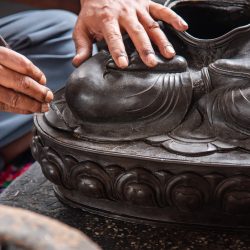
The First Stage of Statue Making: Creating the Wax Figure
October 12, 2026
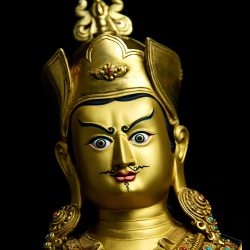
Reading the Sacred Image of Guru Padmasambhava
July 31, 2026

The Journey of Creating a 48-Inch Guru Rinpoche Statue
February 27, 2025
Categories
- Events (1)
- Guide (1)
- Iconography (3)
- Uncategorized (1)

Subscribe
Subscribe to our newsletter to get the latest updates. If you'd like to connect with us, please do not hesitate. We are happy to hear from you. You will also find Rupa Maker on Facebook, Instagram.
